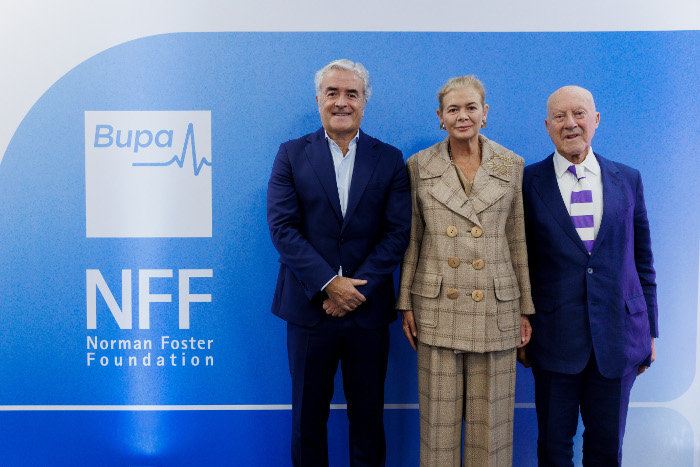
- Bupa and the Norman Foster Foundation are extending their partnership, established in 2022, with a shared ambition to create healthier, more sustainable cities
- The new programme will work with cities to address locally identified health and environmental challenges by combining public and anonymised health, environmental and urban data with advanced modelling and visualisation
- Cities will be able to test potential interventions, such as increasing green space, improving walkability and cycling infrastructure, creating cooler public spaces enhancing neighbourhood wellbeing, and assess their impact on citizens’ health before investing in them
Bupa and the Norman Foster Foundation today announced the next phase of their partnership, launching a new global programme that will work with cities to address the health and environmental challenges that matter most to their communities.
Shaped by insights gained through years of collaboration with city leaders, urban experts and communities, the programme is designed around locally identified priorities, helping cities make healthier decisions based on their specific needs and circumstances.
The programme builds on more than a decade of learning from Bupa's Healthy Cities programme, which has supported cities around the world to create healthier urban environments by increasing access to nature, encouraging active lifestyles and strengthen community wellbeing. Together with the Norman Foster Foundation and a network of partners, these experiences have reinforced the need for practical, evidence-based approaches that help cities understand the links between health and the built environment.
Combining health, environmental and urban data with advanced modelling and visualisation, the programme will help city leaders understand how the places where people live affect their health and support informed decisions about future urban investment and development.
The ambition is to bring health into the urban decision-making process. Using data and predictive modelling, cities will be able to explore the potential health impact of interventions before they are implemented, from expanding green space and creating cooler public spaces to improving walking and cycling infrastructure, reducing exposure to air pollution and strengthening opportunities for social connection.
Recognising that health is shaped not only by healthcare, but also by the places where people live, work and spend their everyday lives, the programme will connect data that is often analysed separately to generate practical insight for action.
Bupa and the Norman Foster Foundation will work with participating cities to identify local priorities, analyse relevant data and model potential interventions. By combining local knowledge with public and anonymised health, environmental and urban data, cities will be able to explore evidence-based solutions tailored to their specific challenges and ambitions.
The programme will operate at multiple levels, from whole cities to individual neighbourhoods and streets, helping decision-makers test ideas, understand potential outcomes and consider health alongside other priorities when planning changes to their urban environments.
Iñaki Ereño, CEO, Bupa, said: "Healthcare is changing. Data gives us an opportunity not simply to understand health, but to help prevent ill health by informing decisions about the environments in which people live.
By looking beyond traditional healthcare settings and understanding the factors that influence health in everyday life, we can help people stay healthier for longer.
This next phase of our partnership with NFF will bring together different sources of data to better understand the relationship between our health and where we live and turn that knowledge into action. Importantly, this is not a programme designed for cities, but with cities. By focusing on the challenges local leaders identify, we can co-create practical, evidence-based solutions that support healthier lives, stronger communities and more resilient urban environments."
Lord Norman Foster, Chair, Norman Foster Foundation, said: “Cities are among our most powerful instruments for improving quality of life. The challenge is to understand more clearly how the decisions we make about streets, mobility, public space, nature and buildings affect human health. Data and predictive modelling now allow us to test those relationships before we act. Combined with design, that gives cities a powerful tool: the ability to compare alternatives, understand their consequences and make more informed decisions. This partnership is about turning evidence into action and using design and technology to help create healthier, more resilient cities.”
The programme aims to work with up to 30 cities across Bupa's markets worldwide. Rather than applying a single global model, it will support cities in addressing the health and environmental challenges most relevant to their communities through a tailored, locally led approach.
The next phase of the partnership brings together Bupa’s health expertise and insights with the NFF’s expertise in design and the built environment, together with the Norman Foster Institute (NFI) Centre for City Science’s expertise in data, modelling and visualisation and a wider network of academic and technical partners.
Together, this combined knowledge will be put at the service of cities, helping leaders tackle today's urban challenges while creating healthier, more resilient environments for future generations.
Partnership background
The collaboration between Bupa and the Norman Foster Foundation began in 2022 with a series of Healthy Cities debates in Madrid. The partnership subsequently expanded through NFI, an initiative of NFF, bringing together 67 scholars and working with nine cities on real-world urban challenges.
The partnership has convened leaders from health, architecture, urban planning and policy to explore how cities can create healthier environments for their communities.
The new programme also builds on Bupa's Healthy Cities programme, which has supported urban health projects across Bupa markets and fostered longstanding relationships with city leaders, communities and delivery partners. Through initiatives ranging from urban greening and active mobility to community wellbeing, Bupa has developed a deeper understanding of the role place plays in shaping health outcomes.
This next phase represents a natural evolution of that journey, combining lessons from years of city engagement with the Norman Foster Foundation's expertise in urban science, modelling and design to create a scalable, city-led approach to healthier urban environments.
Media enquiries
Hattie Underwood, Senior External Communications Manager, Bupa: [email protected]
About Bupa
Established in 1947, Bupa's purpose is helping people live longer, healthier, happier lives and making a better world. We are an international healthcare company serving 68 million customers worldwide. With no shareholders, we reinvest profits into providing more and better healthcare for the benefit of current and future customers. Bupa has businesses around the world, principally in Australia, the UK, Spain, Poland, Chile, Hong Kong SAR, India, Türkiye, Brazil, Mexico and New Zealand. We also have associate businesses in Saudi Arabia.
About the Norman Foster Foundation
The Norman Foster Foundation (NFF) promotes interdisciplinary thinking and research to help new generations anticipate and address the challenges facing cities and the built environment. Through education, research, design and innovation, NFF brings together architecture, engineering, technology and the social sciences to explore practical solutions that improve quality of life.
NFF’s work includes research and design initiatives, international workshops and public programmes, as well as NFI, which advances education and applied research around the future of cities. Through collaborations with cities, academic institutions, industry and international organisations, NFF seeks to translate knowledge into action and contribute to more sustainable, resilient and equitable urban environments.