Accessibility enables us to be ourselves
Accessibility isn’t just about policies or adjustments. It’s about helping people to show up with confidence and independence – so they can be themselves, at work and in everyday life. To mark Global Accessibility Awareness Day, we're sharing Rashid's story and what accessibility means in practice.
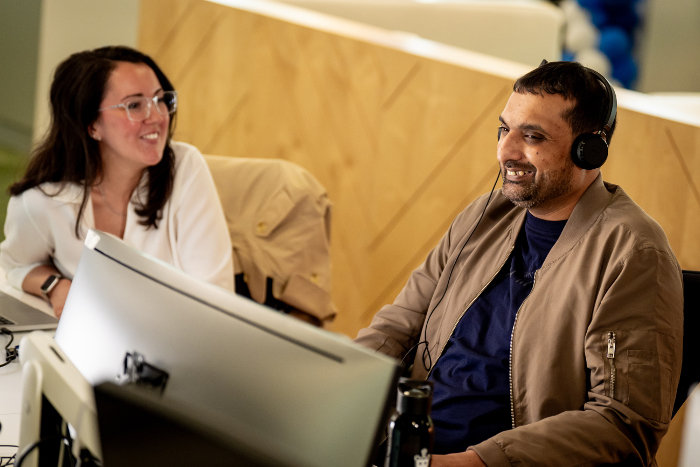
For Rashid, a Business Improvement Associate for Bupa UK, accessibility shapes how he navigates the world each day, and in his role, he brings a different perspective, helping to improve experiences for both customers and colleagues.
As his manager, Steph reflects: “Rashid has challenged us to think differently about accessibility – not as something to add later, but something to consider from the start.”
In this short film, Rashid shares his experience of living and working with sight loss, and the role accessibility enables in practice.
Audio description included. Subtitles are available via ‘CC’.
Rashid was born with retinitis pigmentosa, a condition that led to sight loss earlier than expected. The transition was difficult. He had to learnt to navigate life independently, adapt to new ways of working, and build confidence in unfamiliar settings and routines.
Today, accessibility shows up in how Rashid lives each day. It’s knowing where you are and how to move through a space. It’s being able to use technology even when it’s not designed with you in mind. And it’s being able to do your job with the same independence as anyone else.
At work, Rashid uses tools like screen readers to navigate systems in ways that many people never see. What appears seamless often involves unseen effort and adaptation.
But accessibility is not only about tools, it’s also about how others interact with you day to day. “If I had any advice for my colleagues, it would be don’t be afraid to ask questions and don’t make assumptions” he says.
Turning experience into action
While no single experience represents everyone, stories like Rashid’s help highlight why listening to people’s experience of disability matters and why it needs to shape how organisations act.
At Bupa, we are committed to continuing to learn and improve how we approach accessibility in practice, and this is underpinned by our global Accessibility Commitments, which set out how we aim to create inclusive environments and experiences for our colleagues and customers around the world.
Our Accessibility Advocacy Forum brings together colleagues with disability, health conditions and neurodivergence, alongside teams across the organisation, to help inform how accessibility measures evolve. Bringing these perspectives together helps ensure accessibility is considered and designed with real-life experiences in mind, from policy to technology, and influences decisions such as how support is provided.
Colleague networks, such as the Be You Network, also provide a space for colleagues, including Rashid, to share their experiences, connect with others, and raise issues that matter to them. Across a global workforce of 100,000 colleagues, these networks help ensure people feel supported and able to do their best work, while keeping their experience at the heart of Bupa’s accessibility approach.
What this means in practice
Accessibility directly affects how people experience work, healthcare and everyday life.
When environments and behaviours are inclusive by design, they support better outcomes both for our colleagues and for our 68 million customers around the world. Whether that’s a colleague being able to do their job effectively, or a customer feeling understood when accessing healthcare, we see it as our responsibility to keep improving how we serve them.
For Rashid, contributing to this progress is something he cares deeply about. “The changes that are happening make me really proud, because it makes a real difference in someone’s life.”
Looking ahead
There is still more to do.
Accessibility isn’t something that can be “completed”. It is an ongoing commitment and evolves as people’s needs and environments change. Progress depends on continuing to listen, to challenge assumptions, and to involve people with experience of disability in shaping what comes next.
This means continuing to listen. Continuing to learn. And continuing to build environments where everyone can participate fully and be themselves.